Emilie Bauhofer & Andreas Hahmann
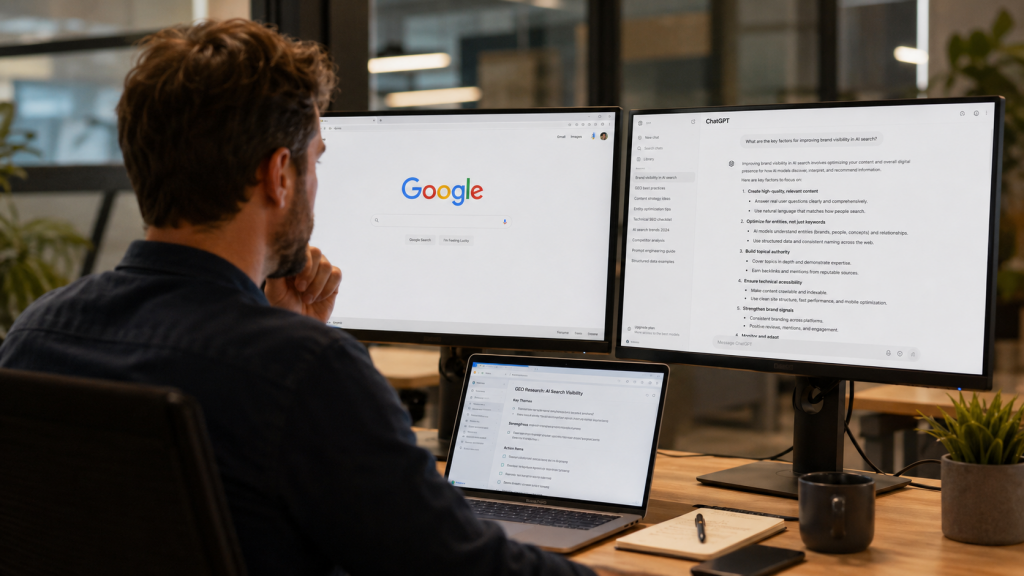
The rapid diffusion of generative artificial intelligence (GenAI) and large language models (LLMs) has significant influence on how consumers access and process information. Since the public launch of OpenAI’s ChatGPT in 2022, user behavior has increasingly shifted from keyword-based search toward conversational, answer-driven interactions. As a result, traditional search engine optimization (SEO) is no longer the sole mechanism determining digital visibility.
Instead of presenting ranked lists of links, generative systems synthesize answers and directly recommend products, services, or brands. This transformation introduces a new layer of visibility that is governed not by retrieval algorithms alone, but by generative inference. Consequently, firms face a critical question: how can they ensure visibility in LLM-generated outputs?
This article reviews recent research on generative engine optimization (GEO) as an emerging extension of SEO and outlines how firms can adapt their digital marketing strategies to remain competitive in this shifting landscape.
From Search Engines to Generative Engines
The Role of SEO in Digital Visibility
For decades, SEO has been the dominant strategy for achieving online visibility. By aligning website content with search engine algorithms, firms could improve their ranking on search engine results pages (SERPs) and thereby increase organic traffic.
Two key mechanisms drove this system:
- Content relevance, typically optimized through keywords
- Authority signals, such as backlinks and domain credibility
Higher rankings translated directly into higher click-through rates, making SEO a central component of digital marketing strategy.
The Shift Toward Generative AI
Generative engines fundamentally alter this paradigm. Instead of ranking indexed web documents, LLMs generate responses by combining learned patterns from large-scale training data with retrieved external information.
This shift has three important implications:
- From links to answers
Users consume information directly instead of navigating to websites.
- From ranking to inclusion
Visibility depends on whether a brand is mentioned in the generated response at all.
- From keywords to semantics
Models interpret intent and context rather than relying on exact keyword matches.
As a result, traditional SEO alone may no longer be sufficient to ensure visibility.
What Is Generative Engine Optimization (GEO)?
Generative engine optimization can be defined as the strategic adaptation of content and digital assets to increase visibility within LLM-generated outputs.
Unlike SEO, GEO operates in a black-box environment, where the underlying mechanisms of content selection and ranking are not fully transparent. Instead of optimizing for explicit ranking factors, firms must align content with how LLMs interpret, retrieve, and synthesize information.
Importantly, GEO does not replace SEO. Rather, it builds upon it, creating a complementary relationship between both approaches.
Key Levers to Influence Visibility in LLMs
1. Content Enrichment and Clarity
Empirical evidence shows that content quality remains an important driver of visibility. However, the definition of quality shifts toward LLM interpretability.
Effective tactics include:
- Adding quotations and citations
- Incorporating quantitative evidence
- Improving fluency and readability
- Structuring content in a clear, logical format
These elements have been shown to increase the likelihood that LLMs retrieve and integrate content into their generated answers.
2. Intent Alignment and Semantic Optimization
Generative systems prioritize semantic alignment with user intent rather than surface-level keyword matching.
This implies that firms should:
- Focus on question-based content formats
- Address specific user problems
- Use natural, conversational language
Content that clearly reflects user intent is more likely to be selected and synthesized by LLMs.
3. Brand Credibility and Trust Signals
LLMs tend to favor credible and authoritative sources. As a result, traditional brand-building activities gain additional importance.
Relevant signals include:
- Customer reviews and ratings
- Media coverage and third-party endorsements
- Consistent brand presence across platforms
In this context, brand reputation becomes not only a consumer-facing asset but also a data signal influencing AI recommendations.
4. Psychological Framing Effects
Interestingly, LLMs appear sensitive to cognitive biases embedded in content, similar to human decision-making.
For example:
- Social proof (e.g., “used by thousands of customers”) increases visibility
- Discount framing enhances recommendation likelihood
- Scarcity or exclusivity cues may reduce inclusion
This suggests that traditional marketing principles continue to apply in AI-mediated environments. However, firms must recognize that certain cues intended to influence human consumers may be interpreted differently by LLMs and can even produce unintended or opposite effects on visibility and recommendation likelihood.
5. Advanced Manipulation Techniques (with Caution)
More advanced approaches attempt to directly influence LLM outputs through prompt-injection or adversarial techniques.
These include:
- Strategically modifying product descriptions
- Embedding hidden instructions in content
- Manipulating evaluation criteria used by LLMs
While such methods can significantly improve ranking, they introduce ethical, legal, and reputational risks. Firms should therefore approach these techniques with caution and prioritize long-term credibility.
The Relationship Between SEO and GEO
A central insight is that SEO and GEO are not substitutes but complements.
Core SEO principles remain highly relevant:
- High-quality, user-oriented content
- Structured data and technical optimization
- Positive user engagement metrics
These elements not only improve search rankings but also enhance the likelihood of being included in LLM-generated outputs.
From a managerial perspective, this creates an opportunity for efficiency gains: investments in content quality and brand building simultaneously support both SEO and GEO.
Managerial Implications
The rise of generative engines has several important implications for digital marketing strategy.
- Extend SEO into GEO
Firms should expand existing SEO practices to include generative platforms rather than replacing them. This allows firms to manage visibility across both search results and AI-generated answers, while using overlapping content and optimization routines.
- Invest in Content Quality and Structure
Content must be optimized not only for users but also for machine interpretation. Accordingly, firms should ensure that information is easy to identify, substantiate, and integrate by using clear structure, credible evidence, and precise wording.
- Strengthen Brand Credibility
As LLMs incorporate trust signals into their recommendations, investments in brand equity may directly influence AI visibility. Therefore, reviews, media coverage, third-party endorsements, and consistent brand presence become relevant not only for consumers but also for how LLMs represent brands.
- Develop AI Capabilities
Understanding how LLMs process and generate information requires new competencies. Hence, building capabilities to monitor AI-generated brand representations, audit output accuracy, and internal collaboration between marketing and data science teams becomes increasingly important.
- Act Early to Capture First-Mover Advantage
As with early SEO, firms that adopt GEO early can build capabilities, data assets, and brand associations that are difficult for competitors to replicate. Early engagement enables firms to learn which content and credibility signals matter most before GEO practices become more standardized.
Conclusion
Generative AI is not merely a technological trend but a structural shift in how information is accessed and consumed. As LLMs increasingly mediate the customer journey, visibility within AI-generated outputs becomes a critical determinant of market success.
Generative engine optimization provides a framework for addressing this challenge. By extending established SEO principles and adapting them to the logic of generative systems, firms can secure visibility, strengthen reputation, and create sustainable competitive advantage.
In the long run, those organizations that successfully integrate GEO into their digital strategies will not only be discovered more frequently but will also shape how markets are represented and understood in an AI-driven economy.
References
-
Abel, Godard (2025), “G2 and Profound Partnership Powers B2B Software Companies’ AEO and AI Search Marketing Strategies,” (published online September 11, 2025), https://company.g2.com/news/g2-profound-partnership.
-
Adobe (2025), “Adobe LLM Optimizer Empowers Businesses to Drive Brand Visibility as Consumers Embrace AI-Powered Browsers and Chat Services,” press release (June 16, 2025), https://news.adobe.com/news/downloads/pdfs/2025/06/llm-updated.pdf.
-
Aggarwal, Pranjal, Vishvak Murahari, Tanmay Rajpurohit, Ashwin Kalyan, Karthik Narasim-han, and Ameet Deshpande (2024), “GEO: Generative Engine Optimization,” ACM KDD ’24, August 25–29, 2024, Barcelona, Spain, https://doi.org/10.1145/3637528.
-
Amer, Eslam, and Tamer Elboghdadly (2024), “The End of the Search Engine Era and the Rise of Generative AI: A Paradigm Shift in Information Retrieval,” International Mobile, In-telligent, and Ubiquitous Computing Conference (MIUCC), Cairo, Egypt, 2024, https://ieeexplore.ieee.org/document/10783559.
-
Antrophic (2023), “Introducing Claude,” (published online March 14, 2023), https://www.anthropic.com/news/introducing-claude.
-
Banh, Leonardo, and Gero Strobel (2023), “Generative artificial intelligence,” Electronic Markets, 33, https://doi.org/10.1007/s12525-023-00680-1.
-
Baye, Michael R., Babur De los Santos, and Matthijs R. Wildenbeest (2016), “Search Engine Optimization: What Drives Organic Traffic to Retail Sites?” Journal of Economics & Management Strategy, 25 (1), 6–31.
-
Berman, Ron, and Zsolt Katona (2013), “The Role of Search Engine Optimization in Search Marketing,” Marketing Science, 32 (4), 644–651.
-
Bianchi, Tiago (2025), “Online search market worldwide – statistics & facts,” (published online April 29, 2025), https://www.statista.com/topics/1710/search-engine-usage/#topicOverview.
-
Chang, Woondeog, and Jungkun Park (2024), “A comparative study on the effect of ChatGPT recommendation and AI recommender systems on the formation of a consideration set,” Journal of Retailing and Consumer Services, 78, https://doi.org/10.1016/j.jretconser.2024.103743.
-
Chen, Jun-Cheng, and Sylvain Sénéchal (2023), “The reciprocal relationship between search engine optimization (SEO) success and brand equity (BE): an analysis of SMEs,” European Business Review, 35 (5), 860–873.
-
Chen, Qiyuan, Jiahe Chen, Hongsen Huang, Qian Shao, Jintai Chen, Renjie Hua, Hongxia Xu, Ruijia Wu, Chuan Ren, and Jian Wu (2025a), “Beyond Keywords: Driving Generative Search Engine Optimization with Content-Centric Agents,” arXiv (September 6), https://doi.org/10.48550/arXiv.2509.05607.
-
Chen, Xiaolu, Haojie Wu, Jie Bao, Zhen Chen, Yong Liao, and Hu Huang (2025b), “Role-Augmented Intent-Driven Generative Search Engine Optimization,” arXiv (August 15), https://doi.org/10.48550/arXiv.2508.11158.
-
Dubois, David, John Dawson, and Akansh Jaiswal (2025), “Forget What You Know About Search. Optimize Your Brand for LLMs,“ Harvard Business Review (published online June 4, 2025), https://hbr.org/2025/06/forget-what-you-know-about-seo-heres-how-to-optimize-your-brand-for-llms.
-
Erdmann, Anett, Ramón Arilla, and José M. Ponzoa (2022), “Search engine optimization: The long-term strategy of keyword choice,” Journal of Business Research, 144, https://doi.org/10.1016/j.jbusres.2022.01.065.
-
Ferraris, Andrea Filippo, Davide Audrito, Luigi Di Caro, and Cristina Poncibò (2025), “The architecture of language: Understanding the mechanics behind LLMs,” Cambridge Forum on AI: Law and Governance, 1, https://doi.org/10.1017/cfl.2024.16.
-
Filandrianos, Giorgos, Angeliki Dimitriou, Maria Lymperaiou, Konstantinos Thomas, and Giorgos Stamou (2025), “Bias Beware: The Impact of Cognitive Biases on LLM-Driven Product Recommendations,” arXiv (September 19), https://doi.org/10.48550/arXiv.2502.01349.
-
Gunjan, Vinit Kumar, Pooja, Monika Kumari, Amit Kumar, and Allam appa rao (2012), “Search engine optimization with Google,” IJCSI International Journal of Computer Science Issues, 9 (1), 206–214.
-
Halberstadt, Jantje, Sophia Kollhoff, Sascha Kraus, Amandeep Dhir (2022), “Early bird or early worm? First-mover (dis)advantages and the success of web-based social enterprises,” Technological Forecasting & Social Change, 181, https://doi.org/10.1016/j.techfore.2022.121784.
-
Hertlein, Antonia (2025), “Mit SEO zu GEO: Mehr Sichtbarkeit in generativen KI-Systemen,” e-commerce magazin (April), 44–45.
-
Klesel, Michael, and H. Felix Wittmann (2025), “Retrieval-Augmented Generation (RAG),” Business & Information Systems Engineering, 67 (4), 551–561.
-
Kristensen, Ida, Oliver Bevan, and Sean Brown (2024), “Managing the risks around generative AI,” (published online June 12, 2024), https://www.mckinsey.com/capabilities/strategy-and-corporate-finance/our-insights/managing-the-risks-around-generative-ai.
-
Kumar, Aounon, and Himabindu Lakkaraju (2024), “Manipulating Large Language Models to Increase Product Visibility,” arXiv (September 2), https://doi.org/10.48550/arXiv.2404. 07981.
-
Li, Xitong, Jörn Grahl, and Oliver Hinz (2021), “How Do Recommender Systems Lead to Consumer Purchases? A Causal Mediation Analysis of a Field Experiment,” Information Systems Research, 33 (2), 620–637.
-
Makhov, Vitalii (2025), “ChatGPT-Statistiken enthüllt – Vom Benutzerwachstum bis zur wirtschaftlichen Auswirkung,” (published online September 11, 2025), https://doit.software/de/blog/chatgpt-statistiken.
-
Makrydakis, Nektarios S, Dimitris Spiliotopoulos, and Afroditi Lymperi (2025), “Analysis of search engine optimization tactics in the context of digital marketing for enhancing web-sites ranking and visibility in Generative AI and large language models,” International Journal of Research in Management, 7 (1), 1107–1113.
-
McCoy, Julia (2024), “How to gain visibility in generative AI answers: GEO for Perplexity and ChatGPT,” (published online November 11, 2024), https://searchengineland.com/how-to-gain-visibility-in-generative-ai-answers-geo-for-perplexity-and-chatgpt-448121.
-
Mustak, Mekhail, Joni Salminen, Matti Mäntymäki, Arafat Rahman, and Yogesh K. Dwivedi (2023), “Deepfakes: Deceptions, mitigations and opportunities,” Journal of Business Research, 154, https://doi.org/10.1016/j.jbusres.2022.113368.
-
Nagpal, Mayank, and J. Andrew Petersen (2021), “Keyword Selection Strategies in Search En-gine Optimization: How Relevant is Relevance?” Journal of Retailing, 97 (4), 746–763.
-
OpenAI (2025a), “ChatGPT usage and adoption patterns at work,” report, OpenAI (September 22).
-
OpenAI (2025b), “Wir stellen vor: ChatGPT Atlas, der Browser mit integrierter ChatGPT-Funktion,” (published online October 21, 2025), https://openai.com/de-DE/index/introducing-chatgpt-atlas/.
-
Padilla, Nicolas, H. Tai Lam, Anja Lambrecht, and Brett Hollenbeck (2025), “The Impact of LLM Adoption on Online User Behavior,” SSRN (August 22), https://dx.doi.org/10.2139/ssrn.5393256.
-
Page, Lawrence, Sergey Brin, Rajeev Motwani, and Terry Winograd (1999), “The PageRank Citation Ranking: Bringing Order to the Web,” Technical Report, Stanford InfoLab.
-
Peter, David (2025), “Generative-Engine-Optimization: Revolution oder Evolution?” (published online May 28, 2025), https://www.grantthornton.de/themen/2025/generative-engine-optimization-revolution-oder-evolution/.
-
Pfrommer, Samuel, Yatong Bai, Tanmay Gautam, and Somayeh Sojoudi (2024), “Ranking Manipulation for Conversational Search Engines,” Proceedings of the 2024 Conference on Empirical Methods in Natural Language Processing, https://aclanthology.org/2024.emnlp-main.534/.
-
Pichai, Sundar, and Demis Hassabis (2023), “Introducing Gemini: our largest and most capable AI model,” (published online December 6, 2023), https://blog.google/technology/ai/google-gemini-ai/.
-
Qian, Yaoyao, Yifan Zeng, Yuchao Jiang, Chelsi Jain, and Huazheng Wang (2025), “The Ranking Blind Spot: Decision Hijacking in LLM-based Text Ranking,” arXiv (September 23), https://doi.org/10.48550/arXiv.2509.18575.
-
Semrush (2025), “Take control of your AI presence,” (accessed October 31, 2025), https://www.semrush.com/lp/ai-toolkit-1/en/.
-
Seymour, Tom, Dean Frantsvog, and Satheesh Kumar (2011), “History of Search Engines,” International Journal of Management & Information Systems, 15 (4), 47–58.
-
Sommerfeld, Natasha, Megan McCurry, and Doug Harrington (2025), “Goodbye Clicks, Hello AI: Zero-Click Search Redefines Marketing,” (published online in February), https://www.bain.com/insights/goodbye-clicks-hello-ai-zero-click-search-redefines-marketing/.
-
Storey, Veda C., Wei Thoo Yue, J. Leon Zhao, and Roman Lukyanenko (2025), “Generative Artificial Intelligence: Evolving Technology, Growing Societal Impact, and Opportuni-ties for Information Systems Research,” Information Systems Frontiers, https://doi.org/10.1007/s10796-025-10581-7.
-
Tang, Yiming, Yi Fan, Chenxiao Yu, Tiankai Yang, Yue Zhao, and Xiyang Hu (2025), “StealthRank: LLM Ranking Manipulation via Stealthy Prompt Optimization,” arXiv (May 23), https://doi.org/10.48550/arXiv.2504.05804.
-
Teubner, Timm, Christoph M. Flath, Christof Weinhardt, Wil van der Aalst, and Oliver Hinz (2023), “Welcome to the Era of ChatGPT et al.: The Prospects of Large Language Mod-els,” Business & Information Systems Engineering, 65, https://doi.org/10.1007/s12599-023-00795-x.
-
Zhang, Qian, Jie Lu, and Yaochu Jin (2021), “Artificial intelligence in recommender systems,” Complex & Intelligent Systems, 7, https://doi.org/10.1007/s40747-020-00212-w.