
Part 1 of 2: What market-state alignment can teach us about democratic legitimacy
by Stefan Kluge
When I began the first essay of my dissertation, I was haunted by a question that feels both historical and strangely current: what happens when politics is no longer the only actor defining the values that hold a society together? We often talk as if the state writes the moral script and markets merely react. And sometimes we think the opposite: that markets move first and politics only catches up later. But when I looked across the twentieth century, I started to suspect that both stories were too simple. Advertising does not just sell products, and politics does not simply defend fixed values. Over time, both help define what counts as freedom, success, security, and even care. That suspicion became the starting point for this essay: to trace, over 115 years, how market discourse and state discourse moved around each other, learned from each other, and at times displaced one another. That question feels especially current at a moment when many liberal democracies are struggling with crises of legitimacy and with growing doubts about whether their institutions still shape public meaning effectively.
To study that, I built a dataset that links advertisements and editorial pages from The Economist with U.S. Congressional speeches, covering more than a century and more than 1.1 million documents. I then used a multimodal value-detection framework to track not just what was being talked about, but what kind of value world those texts and images were constructing. The essay focuses especially on Benevolence & Affection, because that is where the stakes become visible. Care can be framed as a civic obligation, as something guaranteed by institutions, or as something privatized, personalized, and bought in the marketplace. What interested me was not just whether those meanings changed, but who moved first when they changed.
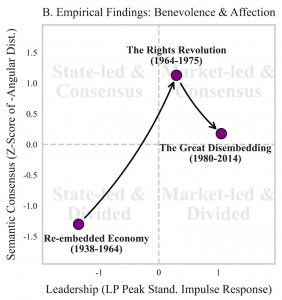
Have a look at the figure. On one axis is leadership: does the state lead, or does the market? On the other is semantic alignment: are both sides talking about care in the same way, or are they drifting apart? What emerges is a three-act story. In the mid-century period, the state clearly leads. Then comes a brief and fascinating equilibrium in the “Rights Revolution,” roughly the era of the civil rights movement, the Vietnam War, and wider social upheaval in the 1960s and early 1970s, when market and state influence each other with almost equal intensity and semantic alignment peaks. After that, the balance breaks. In the late-century period, the market becomes the stronger pacemaker, and the state begins to lose some of its structural language around security and integrity, retreating toward a softer, more therapeutic vocabulary.
That is the part I find most exciting: we should not reduce the market-state relationship to “mirror” versus “mold.” Instead, we can understand it as a moving system with changing tempos, moments of balance, and moments of inversion. That matters because legitimacy crises do not arrive out of nowhere. They can build slowly as institutions fall out of sync with faster-moving commercial discourse. In that sense, this essay is about more than the past. It is about how societies can lose a shared language for collective obligations, but also how moments of semantic alignment and leadership equilibrium may point us toward the conditions under which legitimacy can be renewed.